


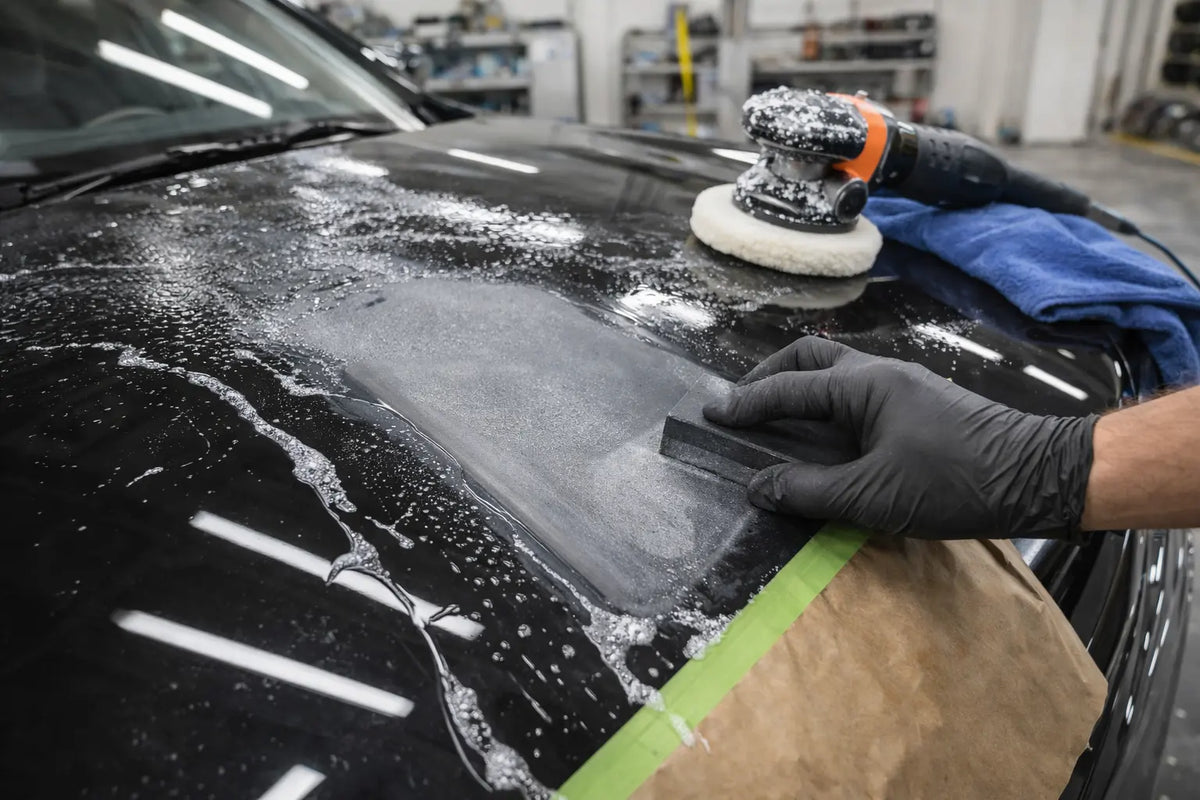
A fresh clear coat job almost never comes out of the booth looking like it belongs on a showroom floor. Orange peel, dust inclusions, small nibs — these are normal. What separates a professional finish from an amateur one is what happens next: wet sanding and buffing the clear coat to a defect-free, high-gloss finish that looks and feels like glass.
This process is where the money is. Customers notice the final finish, not the bodywork underneath. Get this right and you build a reputation. Get it wrong and you burn through clear coat, create holograms, and end up repainting panels.
Before You Start: Is the Clear Coat Ready?
Clear coat must be fully cured before wet sanding. For air-dry clears, that typically means 24–48 hours depending on the product and shop temperature. For baked clears, follow the paint manufacturer's bake schedule — usually 140°F for 30–40 minutes. Sanding undercured clear creates gummy residue, clogs abrasives instantly, and can cause the clear to peel.
Check by pressing your thumbnail into an inconspicuous area (like inside a jamb). If it leaves an impression, the clear isn't ready. Wait longer.
Step 1: Assess the Surface
Before touching sandpaper to the panel, look at the surface under bright light at multiple angles. Identify what you're dealing with:
- Light orange peel: Start at 2000 or 2500 grit
- Moderate orange peel: Start at 1500 grit
- Heavy orange peel or texture: Start at 1000 or 1200 grit
- Dust nibs or small inclusions: Spot-sand with 1500 or 2000 grit, then compound
- Runs or sags: Level with a razor blade first, then wet sand starting at 1000 grit
The goal is to start with the least aggressive grit that will remove the defect. Starting too coarse means more sanding steps to refine the scratch pattern, and more risk of cutting through the clear.
Step 2: Wet Sanding
Soak your sandpaper in clean water for at least 10 minutes before use. Use a firm rubber or foam sanding block — never your bare fingers. Keep the surface flooded with water at all times. The water serves as lubricant, carries away sanding debris, and prevents the paper from loading up.
Sand in straight, overlapping strokes — never in circles. Circular sanding creates a scratch pattern that shows up as swirl marks even after compounding. Keep the block flat and let the abrasive do the work. Don't press hard. Moderate, consistent pressure across the entire block face gives you an even cut without digging in.
Start with your chosen grit and sand the entire panel evenly. When the orange peel is leveled (the surface looks uniformly hazy with no shiny low spots), wipe the panel dry with a microfiber towel and inspect under light. If you still see texture, continue. If it's flat, move to the next grit.
Recommended Wet Sanding Progression
- 1000 → 1500 → 2000 → 3000: For heavy orange peel or runs. Four steps, but the result is dead flat.
- 1500 → 2000 → 3000: For moderate orange peel. This is the most common progression in production shops.
- 2000 → 3000: For light orange peel or dust nib removal. Quick and effective.
3M Trizact P3000 and P5000 discs deserve special mention here. Unlike conventional sandpaper that dulls as you use it, Trizact's structured abrasive design means it breaks down in a controlled way — starting with a coarser cut and progressively becoming finer. A P3000 Trizact disc on a DA sander with a light water mist can replace the hand sanding step at 2000 and 3000 grit, saving significant time on larger panels. Use a soft interface pad on the DA to let the disc follow body contours.
Step 3: Compounding
After wet sanding, the clear coat will look uniformly hazy. Compounding removes the sanding scratches and restores gloss. This is a machine process — hand compounding doesn't generate enough cut or friction to work effectively.
Use a variable-speed rotary or DA polisher with a wool or foam cutting pad. For most jobs, start with 3M Perfect-It Rubbing Compound (step 1 in the Perfect-It system). Apply a quarter-sized amount to the pad, spread it over a 2x2-foot area at low speed, then work it at 1200–1500 RPM with moderate pressure. Keep the pad flat on the surface and moving at all times — stopping in one spot builds heat and can burn through the clear.
Work in sections. After compounding each section, wipe with a clean microfiber and inspect. You should see most of the sanding haze replaced by gloss. Some fine haze from the compound itself is normal — that's what the next step removes.
Step 4: Polishing
Switch to 3M Perfect-It Machine Polish (step 2) with a fresh foam polishing pad. This removes the compounding marks and fine haze left by step 1. Apply and work it the same way but with lighter pressure. The pad should be doing the work, not your arm.
After polishing, wipe the panel and inspect under multiple light angles. The surface should be glossy and free of swirl marks or haze. If you see faint swirls, make another pass with the polish on a clean pad.
For shops that want a final insurance step, 3M Perfect-It Ultrafine Machine Polish (step 3) or Meguiar's M205 Ultra Finishing Polish on a soft black foam pad takes the finish to a show-car level. On dark colors — blacks, deep blues, dark reds — this step is practically mandatory because every imperfection is magnified.
Step 5: Final Wipe-Down
After polishing, remove all compound and polish residue with a quality final wipe solvent or 3M Final Detail Spray. Use a clean, dry microfiber and flip it frequently. Inspect the entire panel one more time under bright, direct light. Look for any remaining haze, holograms (ghostly swirl patterns visible at certain angles), or compound residue in crevices and body lines.
Any compound left in jamb gaps, around trim, or in panel seams will dry white and look terrible when the customer picks up the car. Detail these areas with a soft brush and compressed air if necessary.
Common Mistakes to Avoid
- Sanding too aggressively: You only have 2–3 mils of clear coat. A mil gauge or paint thickness gauge is a worthwhile investment. Check the clear thickness before and during sanding on repainted panels.
- Using a dirty pad: A pad loaded with dried compound is an abrasive, not a polisher. Clean or swap pads regularly during the job.
- Skipping grits: Jumping from 1500 to compound without an intermediate grit leaves deep scratches that compound alone can't fully remove. They show up a week later as the clear coat finishes outgassing.
- Buffing in direct sunlight: Heat from the sun plus friction from the polisher equals burned clear coat. Always buff indoors or in shade.
Products Mentioned
- 3M Trizact P3000 & P5000 Finishing Discs
- 3M Perfect-It Rubbing Compound
- 3M Perfect-It Machine Polish
- 3M Perfect-It Ultrafine Machine Polish
- 3M Wetordry Sandpaper
- Meguiar's M205 Ultra Finishing Polish
Shop our complete line of buffing and polishing products and 3M Perfect-It compounds at RDI.
Back to Pro Tips


